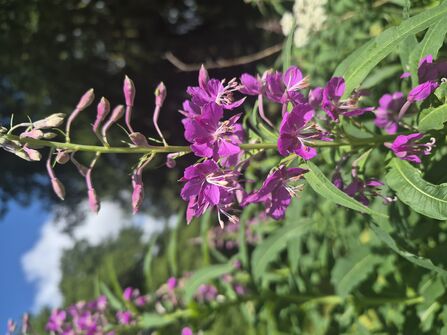

July is the month when rosebay willowherb adds its magnificent magenta flower spikes to our landscape. Alongside the creamy froth of meadowsweet, it is one of the plants that tells me high summer has arrived. The grasses are setting seed, the days seem full of warmth and light, and the school holidays are just around the corner.
Today, rosebay willowherb is such a familiar feature of our landscape that it is easy to assume it has always been here. I see it growing almost everywhere: along roadsides and railway embankments, on neglected urban ground, around woodland clearings and on rough patches of waste land. Yet despite its abundance, it was once regarded as an uncommon plant in Britain before the Industrial Revolution.
The expansion of the Victorian railway network is thought to have played a major role in its spread. Each flower spike can produce up to 80,000 seeds, each equipped with silky hairs that allow it to be carried long distances by the wind. The slipstream created by passing trains provided an ideal means of dispersal, helping the plant colonise new areas. Once established, it spreads vigorously through underground rhizomes, forming dense stands that can quickly dominate a site.
Rosebay willowherb thrives on disturbed, nutrient-rich ground, particularly where fire has been involved. The devastation of the two World Wars created vast areas of suitable habitat. Bomb sites cleared rubble and damaged industrial land provided perfect conditions for the plant to flourish, while large-scale woodland clearance for the war effort opened up further opportunities for expansion. These associations gave rise to two of its common names: fireweed and bombweed.
Like a phoenix rising from the ashes, rosebay willowherb became a symbol of recovery and resilience in post-war Britain. One particularly memorable example occurred in Clydebank, where the Singer Sewing Machine factory was destroyed during the Clydebank Blitz of 1941. The plant rapidly colonised the exposed ground and rubble of the site, earning the local nickname “Singerweed”. Although the name has largely faded from use, it remains a fascinating reminder of the plant's remarkable ability to reclaim damaged landscapes.
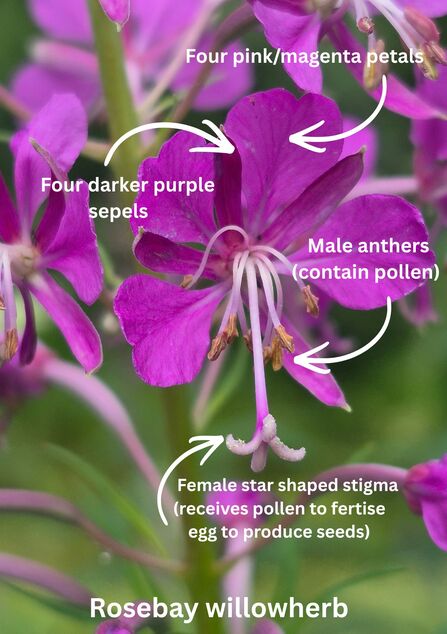
It is well worth taking a closer look at the individual flowers. Each bloom has four bright pink petals and, behind them, four narrower, darker purple sepals. With the aid of a magnifying glass, another interesting feature becomes apparent. The pollen-bearing anthers mature before the stigma at the centre of the flower becomes receptive. This process, known as protandry, helps promote cross-pollination by reducing the likelihood of self-fertilisation. Bees and other insects, attracted by the flower's abundant nectar and pollen, help transfer pollen between plants.
Rosebay willowherb also supports a range of wildlife. One of our most spectacular moths, the elephant hawkmoth, relies on it as an important food plant. Its striking caterpillars feed on the leaves, often growing to impressive sizes before pupating.
Whether admired for its beauty, it’s fascinating history, or its importance to wildlife, rosebay willowherb is one of the defining plants of the British summer. Its vivid flower spikes brighten roadsides, railway banks and woodland edges, reminding me each year that high summer has truly arrived.