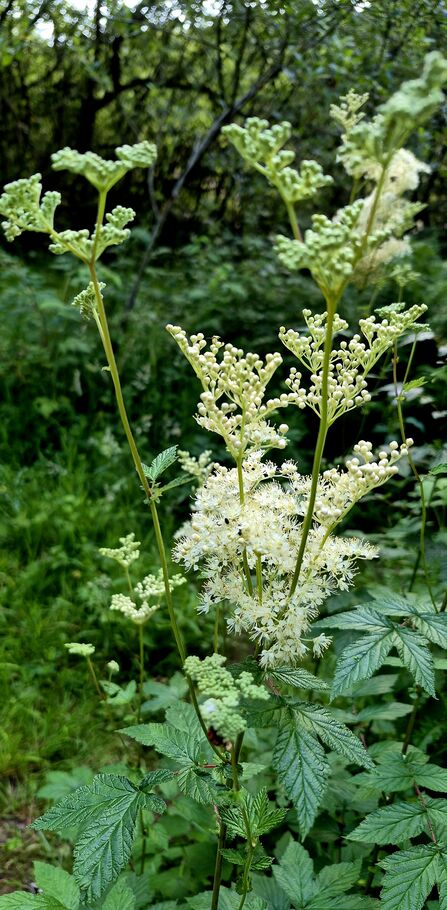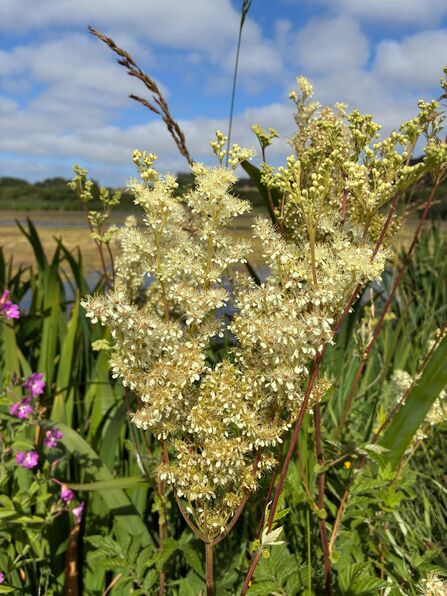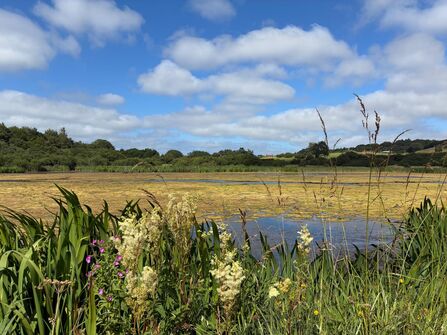

A late‑summer delight for me is the sight of meadowsweet flourishing in damp meadows, stream sides, pond edges and ditches. Wherever it grows in abundance, I can’t help but be drawn to its conspicuous, frothy flowerheads. A closer look reveals that each plume is made up of clouds of tiny, delicate cream flowers. Their soft, fuzzy appearance comes from the protruding stamens, which produce an abundance of pollen. It’s this protein‑rich pollen-rather than nectar-that makes meadowsweet such a magnet for insects, especially bees and hoverflies. No wonder our ancestors called it Queen of the Meadows.
What fascinates me most about meadowsweet is the striking contrast between the scent of its flowers and its leaves. The flowers carry a sweet, almond‑like fragrance and were once used in flavouring mead. But crush the leaves and you get a sharp, medicinal scent. That contrast may explain one of its old colloquial names: Love and Marriage; the flowers representing the sweetness of courtship, the bitter leaves the reality of marriage.
I’ve always thought the leaves smell remarkably like Germolene, that pink antiseptic cream my nana used on our childhood cuts and grazes. A bit of research revealed that Germolene’s characteristic scent comes from extracts of the American herb wintergreen. Although unrelated to meadowsweet, wintergreen contains a similar chemical, methyl salicylate, which is related to aspirin.
Most people know that willow was used as a traditional remedy for pain and fever because it contains salicylate compounds. Meadowsweet, however, has also been used for centuries in European herbal medicine for pain, fever and inflammation. In fact, it played a key role in the development of modern aspirin. In 1838, a German scientist extracted salicylic acid from meadowsweet flower buds, paving the way for further experimentation. Chemists later discovered that acetylating salicylic acid produced a gentler compound. In 1897, Felix Hoffmann at Bayer successfully synthesized acetylsalicylic acid -aspirin as we know it today. Meadowsweet’s natural salicylates provided the blueprint for this breakthrough. If you fancy a deeper dive into the history of the development of aspirin, I recommend reading Aspirin: The Extraordinary Story of a Wonder Drug by Diarmuid Jeffreys for a page turning read that blends botany, medical history, politics and economics.
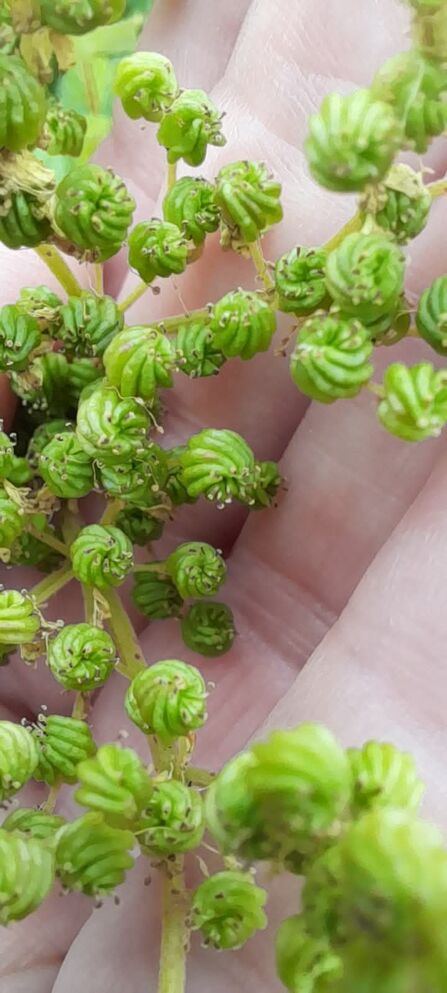
And it’s not just the flowers that reward a closer look. The distinctive seed pods of meadowsweet are exquisite- tight spirals arranged within small pods, forming twisted, ball‑like structures that are every bit as intriguing as the blooms that came before them.