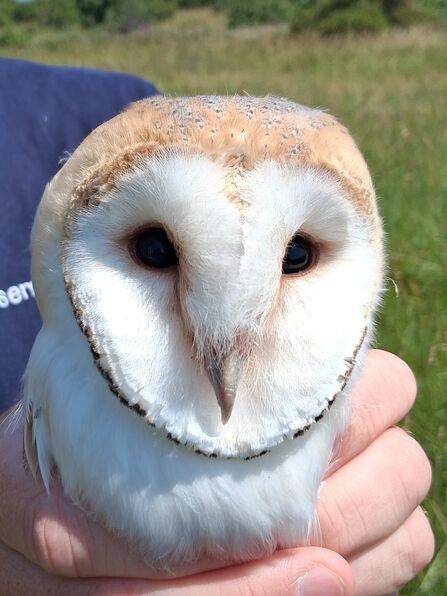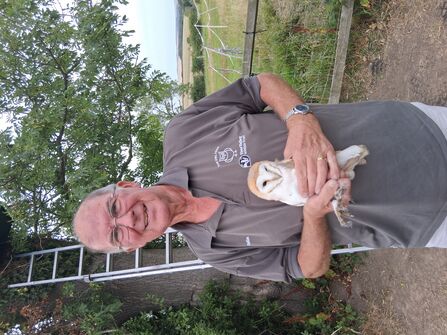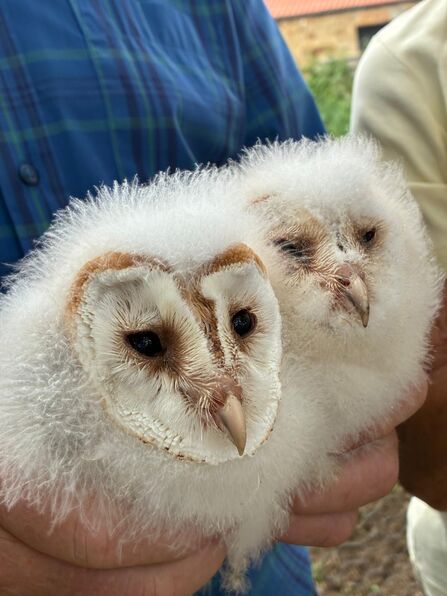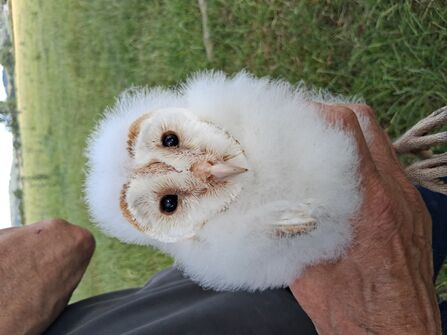
2026 has turned out to be a bumper year for the region’s barn owls. Colin Gibson, lead volunteer for Tees Valley Wildlife Trust’s long running barn owl project said “The breeding success for this season has completely exceeded all expectations. We knew we were in for an interesting year when we found birds had reached breeding condition and started laying two to three weeks early, probably an effect of the mild winter.”
Colin, a licensed bird ringer with the Tees Valley Ringing Group has been on a mission for the past fifteen years to get barn owls back across our landscape. With a small team of volunteers and the support of many landowners he has created a network of over five hundred specially designed nest boxes which are checked throughout the year. “Last year we put rings, which provide important information on owl dispersal and mortality, on 270 barn owl chicks across the network. This year we have put rings on 541 owlets and still counting. We’ve also seen larger clutch sizes and, larger brood sizes, up significantly from the long-term average of 3.0 birds per brood to 3.7 this year. The mild winter, dry summer and plentiful food supply of field voles and other rodents will have contributed to the breeding success.
A major factor in the decline of the barn owl population from the last century was the loss of natural sites in old trees and the bird’s access to old traditionally built farm buildings. “Almost 200 of our boxes have been used for breeding this year providing much needed nesting places. It just goes to show what a difference a £100 barn owl box can make to conservation. As well as barn owls, the boxes have been used by other wildlife species including, tawny owls, kestrels, stock doves, jackdaws, ducks, grey squirrel and the occasional wasp population. “Typically, we find about 75% of our boxes are used by wildlife so it’s always a surprise when we check inside” said Colin.
The barn owl project is funded to a large part by annual box sponsors. The £10 sponsorship helps cover project expenses including bird rings, mileage to check the boxes, construction of new and replacement boxes and project equipment. Each box sponsor receives information on the general location of their sponsored box and email updates during the breeding season (starting late April) of any activity observed by the team in the box. “We are very grateful for the support we receive from the box sponsors to enable us to undertake our successful conservation work.” said Colin. “With the results from this season we definitely need to increase our sponsorship base. By continuing and developing our nest box project we will not only build a more optimistic future for the barn owl but hopefully reinstate the barn owl across the wider Tees Valley and northern North Yorkshire.”
Please note: Barn owl chicks ringed as part of Tees Valley Wildlife Trust's barn owl project are ringed under licence by trained and qualified bird ringers, ensuring the work contributes to national conservation monitoring programmes. Ringing provides valuable data on their movements, survival and breeding success.
You can support the work of the Trust's barn owl programme by sponsoring a barn owl box, or making a donation.