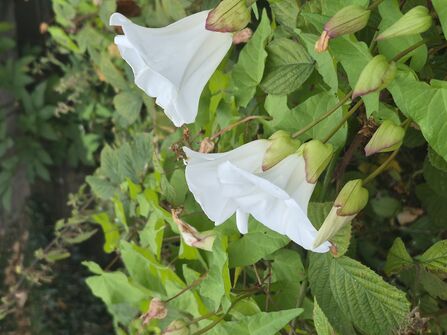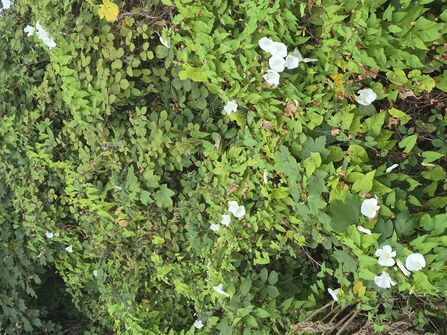

Driving home down a country lane at dusk recently, I noticed the hedgerows adorned with strings of brilliant white trumpet flowers glowing in my headlights. These were, of course, the blooms of hedge bindweed.
This ubiquitous wild plant needs little introduction. In late summer, the conspicuous flowers of this rampant perennial are hard to miss as it scrambles and twists through hedgerows, fences, woodland edges, and almost any patch of open ground, including our gardens and allotments.
With its habit of smothering other plants, it is easy to see why many gardeners and conservationists regard hedge bindweed as a foe rather than a friend. It spreads through an extensive rhizomatous root system and can regenerate from root fragments as small as an inch or two long. Its tenacity is reflected in some of its colourful folk names: hellweed, strangleweed, devil's garters, devil's thread, and devil's nightcap. My personal favourite is devil's guts, which perfectly describes the tangled mass of white roots that I carefully try to remove from the potato bed in my garden.
Yet despite its troublesome nature, I am always happy to see its fresh shoots return each spring. I cannot help but admire its resilience. More importantly, hedge bindweed is an excellent plant for pollinating insects. Bees, butterflies such as the gatekeeper, and hoverflies are all attracted to its flowers. The blooms are said to remain open throughout the night, providing nectar for night-flying moths. It is also a larval food plant for several moth species, including the convolvulus hawkmoth and the elephant hawkmoth.
Children have long been fascinated by these giant flowers, which is reflected in the many regional names recorded by plant folklorists, including the late Roy Vickery, whose lectures on plant folklore I was fortunate enough to attend while he was at the Natural History Museum in London. Children would pinch the flowers and squeeze them at the base, sending the white blooms gently floating to the ground like a tiny parachute. This gave rise to charming names such as Granny-pop-out-of-bed. In Dorset and Bedfordshire children chanted, "Granny, granny, pop out of bed", while in Hampshire it became "Lazy Maisie, jump out of bed". In London, one version was the wonderfully eccentric "Polly Had a Dolly and Her Head Popped Off".
It is all too easy to divide plants into categories of good and bad, flower and weed. Yet they are all part of the landscapes we have shaped and modified over centuries. For all the frustration it causes gardeners, I believe our countryside would be a poorer place without hedge bindweed. Its striking flowers brighten our hedgerows, support wildlife, and carry with them a rich thread of folklore and childhood memories. For that reason alone, I am always pleased to see it return each year.