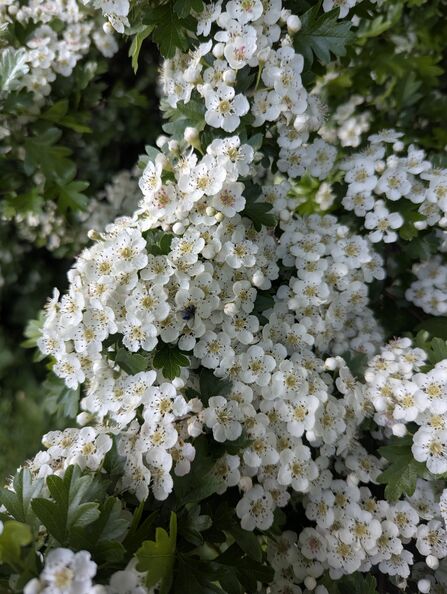

Did you know that the old adage “Cast ne’er a clout ‘til May be out” doesn’t mean keep your jacket on until June, but until the hawthorn is in bloom? When May arrives, hawthorn all over our area becomes more thickly blossomed by the day, highlighting the hedgerows that go greenly unnoticed the rest of the year.
When chatting with a fellow volunteer tree warden, I learned that there are two species of hawthorn in the UK. The Midlands hawthorn blooms earlier than the common, and has rounder, less deeply cut lobes to its leaves. Once May arrives, both bloom wonderfully along all those margins of our fields, roads and railway lines, bringing magic to the places most of us only see out of the corners of our eyes.
Hawthorn has a huge folklore associated with it, as a plant under the protection of the Fae. A lone hawthorn in a field is sometimes considered a gateway to the realm of Faerie, where people might tie ribbons and talismans as offerings. Woe betide you if you destroy it – the Queen herself may come and take you away under the hill! But as the bright sprinkling of the May blossom slowly thickens and envelops the green hedges in an extravagance of white, it does seem like a kind of magic to me. Cinderella’s rags twinkling into a ball gown; a twinkling of white in the thicket materialising into a pale figure in the shadows.
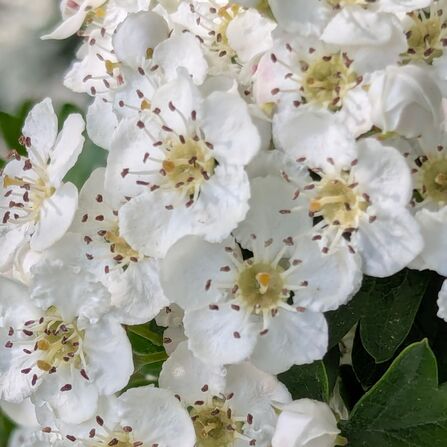
In the poem that follows, I was drawn to both the legends of the hawthorn, and to its structure. Flowers have five petals, and clusters along the boughs usually appear in multiple of fives. My poem uses fives to give it a structure – five verses of five lines of five words each.
Queen of the May
The queen waits for you
at the thin place, pilgrim,
wearing pins inside her sleeves.
White-crowned, cuffed and ruffed,
She’s ready for the wedding.
The queen commands you come,
her gestures fleet as breezes.
Alone in the forgotten field,
bride of the hedgerow, she
is everywhere if you look.
Look for the queen everywhere,
White queen of the May,
Green queen of the Fae.
Your blade turns on you.
Your prayers are in ribbons.
She offers bread and cheese,
but only the foolish eat
at the queen’s long table.
Seven years long, seven years
gone under the green hill.
The queen opens the door
at the thin place, beloved.
She smells as sweet as
pale corpses in plague years,
before the green ground opened.
Hawthorn leaves are edible, and were traditionally called “bread and cheese”. A tea made of them can be used to improve heart health, circulation and blood pressure.
Last year I became so enamoured of this tree that I looked for any growing locally with a tree preservation order on them, then took a journey to visit them. Along the way I ended up chatting to the people whose gardens were graced by these special trees, most of whom had no idea what they had! One conversation took many fascinating turns, which I wrote about in this poem.
Tree preservation order – the Hawthorn next door
The day begins when the birds pray, they say where he is from.
The blackbird in the minaret of next-door’s hawthorn has opened dawn,
and the petals of the pot mums paced along the front path,
and the eyes of the faithful, up twice in the night already with his prostate.
He’s a grandfather now, unforeseen resident of a Victorian villa
on this street lined with rustling linden. Planted in boom-time,
their thousand green hearts applaud the vision of planners long gone.
They say the best time to plant a tree is fifty years ago; second best is now.
His grandfather’s garden was an orchard perfumed with tangerines,
fruitful with guavas, their dense shade the best when summer came beating.
The hawthorn’s toothed leaves sieve the dapple. He pinches one,
breaks it for its small scent, but will not cut down what is protected.
In his homeland also, some trees must not be axed.
Allah, like the Fair Folk, has a stake in some saplings,
but the name of which species is a curlicue void inside the language here.
Our thorny runes are Nordic; haw-, white-, and quick-.
Some trees just can’t leave their lands; transplants fail in both directions.
Others may adapt, blossom, fruit. Carried to London in the holdall
of his father’s new life, he thrived, though his green thumb
had to wither all those brick-built years in his uncle’s shop.
Forty-five years a family man; family calling him now, south to north,
to start again, re-route, re-root; bringing all he has and all he is.
He will make one more life, this one with a garden and grandchildren in it.
It will be sweeter even than the memory of fresh guava on his tongue.
So if you love hawthorn, or if you’ve never really thought about it much, take some time to appreciate it when late spring graces us again. Make sure to appreciate it before all that blossom disappears, and the fairies fade back into their hidden realms, and our hedges are only hedges once again…