
Flourishing on rough grassland and rapidly colonising disturbed soils, teasel needs little introduction. It’s one of those wildflowers that demands attention: tall, statuesque, and architectural, with its conical seedheads standing proudly through autumn and well into winter. Even long after flowering, its silhouette remains a striking feature of the cold‑season landscape.
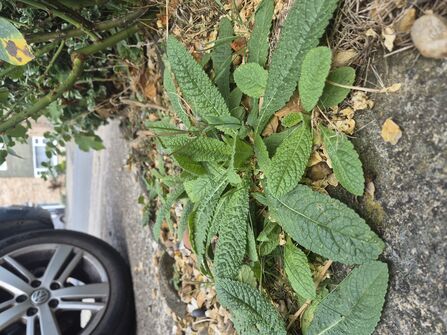
When teasel unexpectedly appeared in my garden, I let it grow, hoping it might tempt goldfinches to feed on its seeds. I did have goldfinches visiting that winter, though whether it was the teasel or the niger seed in my feeder that drew them in, I’ll never know. What I should have anticipated was just how enthusiastically teasel seeds itself. The following year, rosettes appeared in abundance along my front path. Had I transplanted them before they established their taproots, I might have spared visitors and the postman a prickly journey to my front door. Being biennial, they soon reached for the sky.
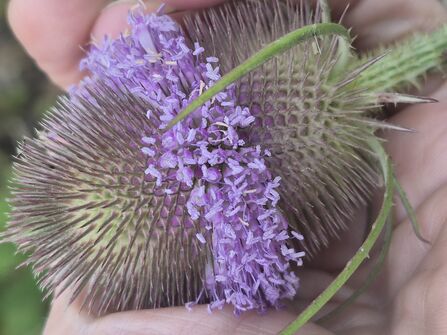
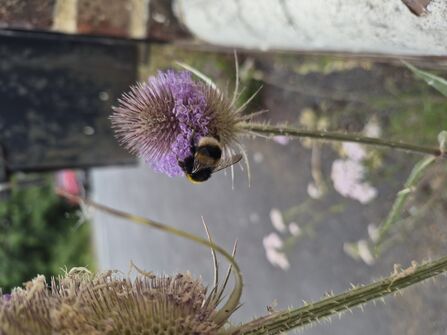
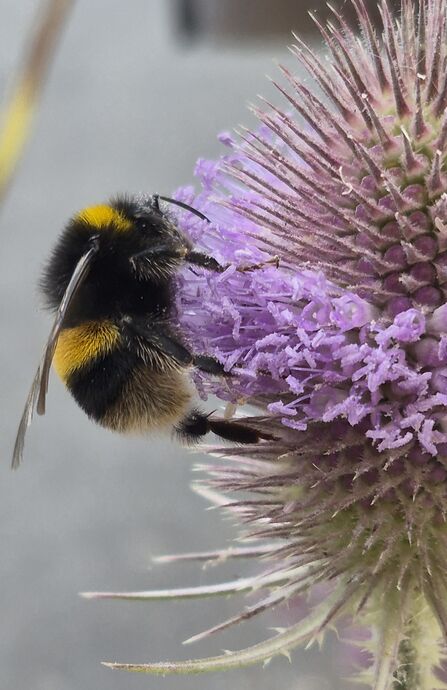
Despite their inconvenient placement, I was rewarded daily by watching them flower and by the constant traffic of insect visitors. Teasel blooms in stages: tiny purple florets appear first in a band around the middle of the head, then open in widening rings up and down the cone. Those nectar-rich flowers are irresistible to hoverflies, bumblebees, solitary bees, honeybees and butterflies and my trip from car to front door was often delayed by joyful encounters with bumblebees.
In December, I harvested seedheads for winter wreath-making workshops I delivered for Tees Valley Wildlife Trust as part of the Naturally Active Libraries project. They were as their dry, sculptural heads, surrounded by their whorl of bracts, look wonderful alongside larch and pinecones.
While making wreaths, we often ended up talking about teasel’s fascinating textile history. The clue is in the name. For centuries, dried teasel heads were used in the wool industry to raise the nap on cloth. Fullers mounted the heads into frames and drew them across the fabric to create a soft, even pile. Although wild teasel (Dipsacus fullonum) was used, it was the cultivated weavers’ teasel (Dipsacus sativus) with its curved, hooked spines that became indispensable. Those spines “give” as they pass over cloth, smoothing rather than snagging. In the Middle Ages, teasel heads were fitted into wooden frames; by the nineteenth century, they were fixed to rotating drums in mills. Even after steel brushes replaced them in most factories, the finest finishes-such as the baize used on high-quality billiard tables were still produced with teasel. A remarkable legacy for a wild plant.
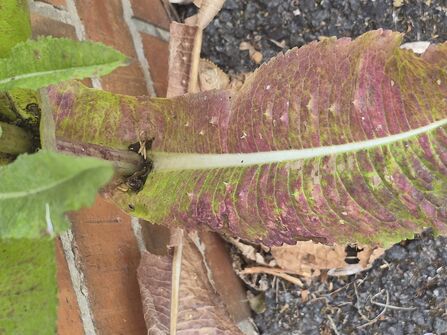
I also love the colloquial names teasel has gathered over the centuries. Some of my favourites - fairies’ brooms, barbers’ brushes and gypsy combs- celebrate the character of its seedheads. Others, like Venus’s basin and Adam’s flannel, refer to the plant’s curious habit of collecting rainwater in the cuplike hollows formed where the leaves clasp the stem. Naturalists have long been intrigued by these little reservoirs. Erasmus Darwin (Charles Darwin’s father) suggested they acted like a moat, preventing insects from climbing the stem, whilst Charles’s son Francis speculated that the teasel may be semi carnivorous, gaining nutrients from insects that drowned in the stem cups. Thought scientific evidence to support the hypothesis remains inconclusive.
Still, the teasel’s water-filled cups add another layer of mystery to a plant already rich in history, folklore and unexpected beauty.