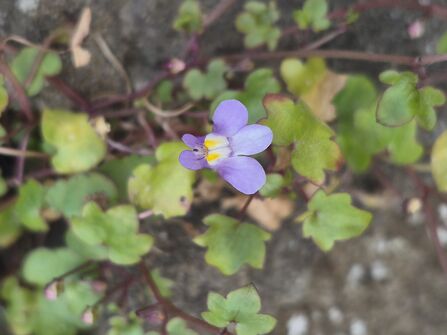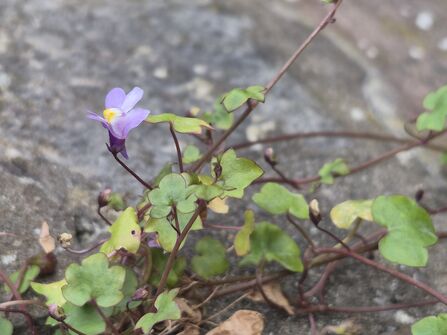

The diminutive flowers of ivy-leaved toadflax may seem an unusual choice as the first plant to highlight, yet there is something irresistibly charming about this tenacious little species. Making its home in old walls, stonework, and pavements, it thrives where many others would fail.
Its tiny lilac, two-lipped flowers - each adorned with two yellowish bulges on the lower lip -resemble miniature snapdragons. Whether trailing gracefully down the weathered walls of ancient castles or creeping determinedly through the cracks of city pavements, ivy-leaved toadflax appears equally at ease.
It may come as a surprise to learn that this familiar plant is not native to Britain. Originating in the Mediterranean, it was first recorded growing wild here in 1640. Having been present for over 400 years, it has long since naturalised, taking full advantage of the niches created by human structures.
One of its most remarkable adaptations lies in how it spreads its seeds. The flower stalks initially grow towards the light, but once pollinated, they exhibit negative phototropism-bending away from the light. This ingenious mechanism directs the seed capsules into dark crevices within walls, where conditions are more favourable for germination.
Its growth habit, ivy-like leaves, and prolific seed production have inspired a host of descriptive local names, including 'hundreds and thousands', 'wandering sailor', and 'coliseum ivy'. My personal favourite, however, is the delightfully whimsical name often used by children: 'wall rabbits'.